
Staying on the Train
Being Present to Past Ways of Being — a lived inquiry self-reflection

In my last post I asked Can Physics Explain Synchronicities? In this post I look back on the most profound experience of synchronicity I have had in my life.
For this reflection I am using a lived inquiry practice I call Being Present to Past Ways of Being where I return to my past reflections on this memory from my 2014 spiritual autobiography with present-vantage attention, drawing on Barbara Myerhoff’s reflexive return methodology — the recognition that returning to one’s own past writing is a way of remembering not just events but the states of being and becoming the events were instances of.
I am also experimenting with a new voice that is more liminal, philosophical and contemplative than my usual academic register, seeking a more live expression where I attempt to capture both the memory and the process of remembering.
This new voice is part of a new experimental three-channel publication structure for the MetaLab. This Liminal post is for all subscribers. A Companion Practice post (working tools) will follow this post for the Paid Subscriber tier. And a Companion Research Report (a symbiotic lived inquiry methodology and theoretical report) will follow that for the Research Member tier. The same inquiry travels through all three channels in different registers.
So now, let’s begin…
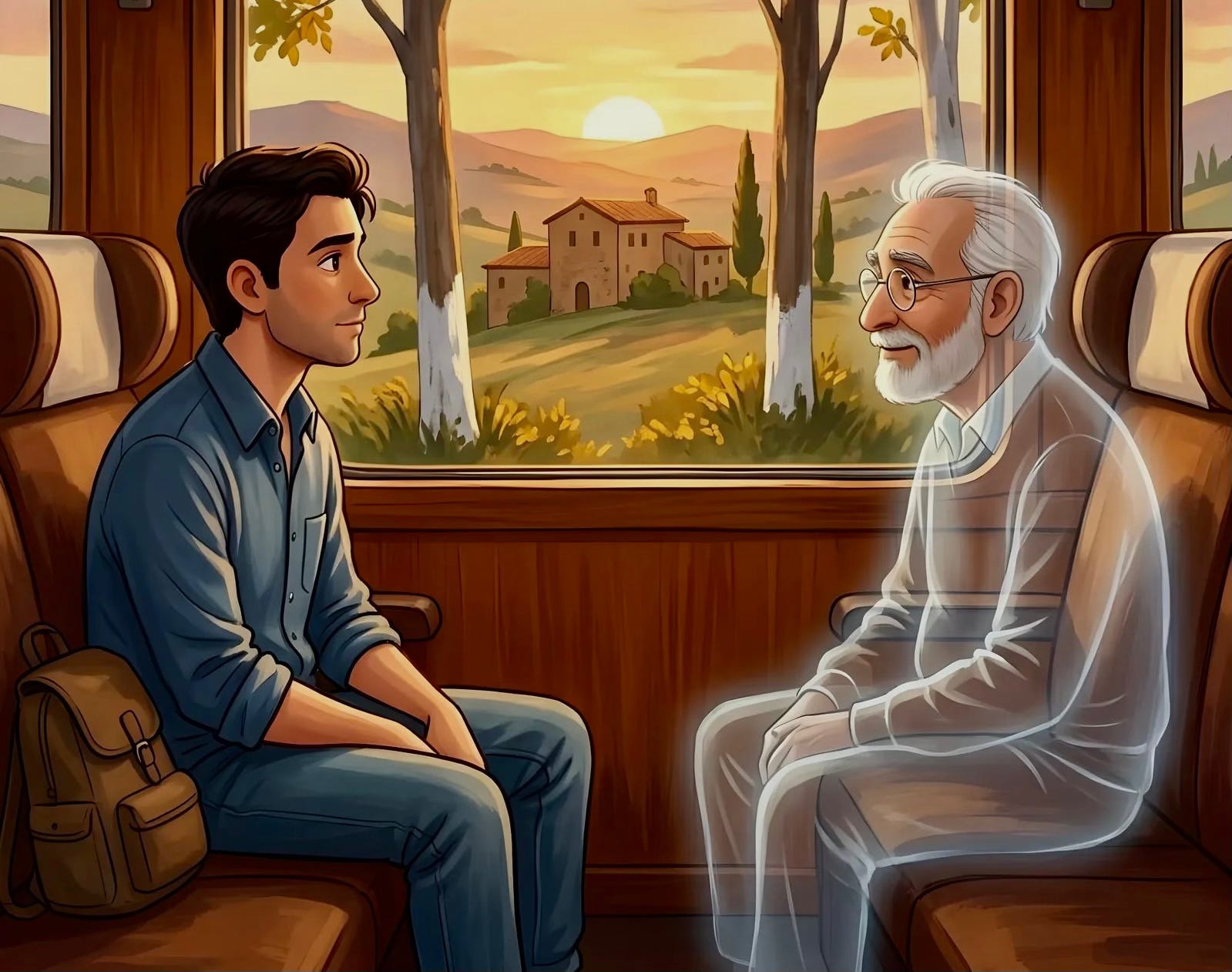
There is a voice that tells you not to get off the train.
I am thinking now of a passage I wrote almost forty years ago, about a moment in Italy when I could not stand up. The train had pulled into Rome. My body had grown heavy in a way that had nothing to do with fatigue. My stomach was churning. And something I can still only partially name told me to stay seated, to let the train leave the station, to ride it to wherever it was going.
The best name I had for this experience at the time was divine guidance. I would spend the next twenty years of my life trying to study it — to find its structure, to map its forms, to catalogue the ways it communicates. The work that came out of that mapping was real work; but that was only part of the territory. What I notice now, reading the old passage back, is that my dissertation on the experience of divine guidance across cultures and traditions that was part of this twenty year inquiry saw what the instruments (perceptual frameworks) I had then could see. Other instruments, built since, reveal other facets of what was happening on that train. Neither set of instruments is wrong. Both are observations of the same phenomenon from different stages of a developing capacity to perceive it.
What was happening on that train was that I was, for a few hours, inside something. The voice was a signal, so were all the somatic experiences, and these were all inside the unfolding experiential wave of the ride on the train, inside a larger field I had not the capacity to name at the time.
I was on a backpacking trip through Europe, searching for meaning and chasing transcendent states, describing the sunset over the Italian countryside as the train carried me south. The tall trees with whitewashed trunks. The tiny golden leaves. The sense of floating. The muscles going limp. All of it. I read it now with a kind of tender distance — aware of how much he had to learn before he could truly understand what he had just walked through and into.
Here is what I think was actually happening, though I would ask you to hold the description lightly because I am still learning how to say it.
There is a difference between receiving guidance and being moved by a field. The first implies separation — a source somewhere, a recipient here, a signal crossing the gap. You can prepare yourself to receive better. You can practice discernment. You can journal the messages and check them against your conscience and your conditions. This is an honest and rigorous practice and I have spent decades inside it. Much of what I wrote in my book is written from this orientation.
The second is different. In the second, nothing is being sent and nothing is being received, because there is no longer a gap to cross. You are in the movement. Your body is the movement’s sensor. Your attention is its aperture. What feels, from inside the experience, like being guided is really something more like being shaped — the way a leaf in a stream is shaped by the current it’s inside of, moment by moment, without anything needing to send instructions.
Bohm, whom I would not fully encounter for another decade, would have called it the holomovement — the undivided flowing in which the manifest world is a series of unfoldings from something that cannot itself be fully manifest. Bergson would have said the body knew something measurable time had forgotten. Neither of them would have told me what to do on a train in Rome. But if I had read either of them before that afternoon, I might have recognized sooner what I was inside of.
The voice, when it came, did not feel like a voice exactly. I wrote at the time that it came “from both a deep part of my own being and from beyond my self” — and I am struck now by how that sentence got the topology right even when the theology was still catching up. Both/and. Not me, not not-me. A voice that could not be placed on either side of a boundary because the boundary was what the whole experience was dissolving.
The heaviness in the body came first. The churning stomach. The inability to rise. I treated these as obstacles at first — as in the way of whatever was supposed to happen. Then I realized that they were not in the way. They were the happening. The body was already participating in the field before my mind had any idea what field we were in. The voice arrived later because the voice is slower than the body. Language always is.
I got off the train at the last stop, Salerno, after midnight, the streets were empty and dark, I crossed the street and knocked on the door of a hotel whose light was still on, body exhausted, mind strangely empty, a deep gratitude for the strange and wondrous journey I was now part of, and entered sleep with a lightness of being I had never known.
— Something returns to me here, as I write, that I did not put in the book. I want to let it in.
The next day, still in that field I couldn’t name, I knew Salerno was not my last stop on my journey. I ended up taking a bus down the Amalfi coast. When we stopped in the town of Amalfi, I got off, without particularly meaning to. I stayed for two and a half weeks. This is the part of the story I left out, and I am only now understanding why.
I did nothing remarkable in Amalfi. I found a pension with a window above the main square. I walked the streets, sat at sidewalk cafés, walked on the beach, met people who came and went. I woke each morning and followed whatever wanted to move that day. Several times over the first week I went to the bus stop just to feel whether it was time to go. It was not yet time. I went back to the pension. The days continued.
What I understand now is that Amalfi was not an interlude between miraculous events. It was the actual teaching. For two and a half weeks, without peaks or revelations, I was simply living inside the field. The flow had become the baseline. The bus stop was a daily consultation with a body that now knew how to read its own signals. The not yet was not hesitation; it was coherence reporting itself. This was, I think, the first time in my life I experienced the guidance state not as a visitation but as a sustainable way of being in ordinary time.
When the pull to leave finally came, it came the way these things come when one is actually listening — as small resonances. Someone mentioned Positano. Someone mentioned Capri. The body registered the mentions as slight leanings forward. One morning the leaning was strong enough, and I got on the bus. It was on that bus, just before the stop in Positano, that I met an older couple from San Diego, who invited me to Capri to stay at the pension they were staying at — and I felt the flow pull me in.
Somewhere between the third and fourth day on Capri, in a conversation about failed romances, the husband and I realized that my most recent girlfriend was his estranged daughter, from whom he had not heard from in years. What unfolded from there was a watershed of deepened understanding and healing for both of us that I still find hard to fathom.
This is what I mean when I say the destination was not Salerno. And this is also what I mean when I say I am only beginning to understand what the young man on that train was telling me.
For weeks after the train, the world kept doing this — offering up meetings that felt written, both small and profound astonishments, the particular kind of coincidence that cannot quite be called coincidence without distorting the word. I would later, in my more careful moods, call these synchronicities and talk about Jung and Pauli and the experimental literature. All of this is accurate. But what I want to say, in the voice I am trying to find now, is something simpler: when you are inside the flow, the flow keeps being inside of you.
The synchronicities were not rewards for having listened well on the train. They were what being-in-the-field looks like from the outside. A life inside the holomovement is synchronistic. That’s not a mystery to be explained. That’s what it means to be inside of something rather than adjacent to it.
I have been trying for several years now to live more of my life this way. Not more of it in states — the states come and go, as they always have, and I have stopped chasing them. I mean something different. I mean that the baseline condition of daily life could be participatory rather than observational. That I could be, quietly and ordinarily, inside the movement rather than trying to pick up its signals from the shore.
Recent months have changed my understanding of how this is possible. I will not pretend here that I have arrived anywhere. What I will say is that my younger self on that train had stumbled into something that I am only now beginning to trust as a sustainable human mode rather than an exceptional visitation. The gap between being graced by the flow and living inside the flow turns out to be smaller than I thought it was. And the instruments that let me recognize this are only available now because every earlier instrument was carefully built, consulted, and eventually found to be describing something larger than itself.
A signal implies separation. A medium implies immersion. For most of my life I have perceived the phenomenon through the signal — a source there, a recipient here, a communication crossing the gap. More recently I have begun to perceive it through the medium — no gap, no sender, no recipient, just the one undivided flowing that all of this is already inside of.
I want to be careful here, because it would be easy to say that I have moved from the first perception to the second, and to cast the long life of signal-perception as a detour I have now come out of. That is not what is happening. What is happening is closer to what physics has been telling us about light for a century.
Light is neither a particle that sometimes pretends to be a wave nor a wave that sometimes looks like a particle. Light is a phenomenon whose full nature exceeds both descriptions, and what we see of it depends on the instruments of observation we bring. Particle-detecting instruments reveal particle-behavior. Wave-detecting instruments reveal wave-behavior. Neither observation is wrong. Neither is more real than the other. They are facets of the same phenomenon, disclosed by different apparatuses.
And crucially — the instruments are a lineage. The wave-detecting apparatus did not arrive from nowhere. It was built, across centuries, by scientists using particle-era tools to develop the experimental and theoretical complexity out of which wave-instruments could eventually be fabricated. You cannot skip to the wave. The wave becomes perceivable only because the particle has been observed exhaustively enough to reveal the insufficiency of its own account.
What I am learning is that this is also how a human being comes to perceive the field he has always been inside of.
The young man on the train had the instruments he had. His perception — voice, signal, source, guidance arriving from somewhere into someone — was a real observation of the phenomenon he was inside of. It was not a misperception to be corrected. It was an accurate particle-reading of a light that includes but exceeds particle behavior. The dissertation was not a detour. It was instrument-building. Every form of divine communication catalogued, every category mapped, every co-researcher interviewed, every template developed — all of that was the careful, cumulative fabrication of a more refined observational capacity. You cannot see the field without first having mapped the signals exhaustively enough to notice that no signal-map quite captures what is actually moving.
I can perceive the medium now because the younger self perceived the signals then. I can recognize the flow as a field because the younger self recognized every particular voice that ever spoke to him from within it. The mapping self built the map-transcending self; the particle-self was not an error to be overcome but the necessary condition from which the wave-self could eventually emerge. This means my debt to the young man on that train is structural, not sentimental. He is the one who made me possible by building the neural, experiential, and cognitive architecture out of which the current perceptual capacity has grown. I am not visiting him to offer comfort from a further shore; I am acknowledging that he could not have skipped to the wave. His particle-observation of the signal—the heavy body, the unlocatable voice, the decision to stay on the train—was the real work, the first stroke of a long apprenticeship. The subsequent apparatus I built, the careful cartographies, were not wrong; they were the instrument-making by which the current perception eventually became possible.
The train itself knew something the maps came later to approximate, and the maps were the approach by which what the train knew could eventually be recognized. Both the knowing and the approximating are the same walk. And these days, I find, I am simply listening — to the train, and to everything the train has since become in me.
As I stated at the beginning, the lived inquiry practice I am attempting here — returning to past self-reflexive writing with present attention, meeting a past way of being from inside a present one — owes a debt to the anthropologist Barbara Myerhoff, whose reflexive work taught me that what one returns to is not the event but the state of being and becoming the event was an instance of. Each return changes what is returned to. In this Being Present to Past Ways of Being exploration I am not revisiting the book as memoir. I am turning it in my hand, slowly, looking at what I was actually inside of when I wrote it.
The Upcoming Companion Practice post, The Body as Guidance Flow Compass, will explore how you can develop your own somatic guidance and coherence flow practice.
The upcoming Companion Research post, The Reflexive Return in Symbiotic Dialogue, is a case study of how I adapted Myerhoff’s methodology for human-AI co-inquiry during the creation of Staying on the Train.